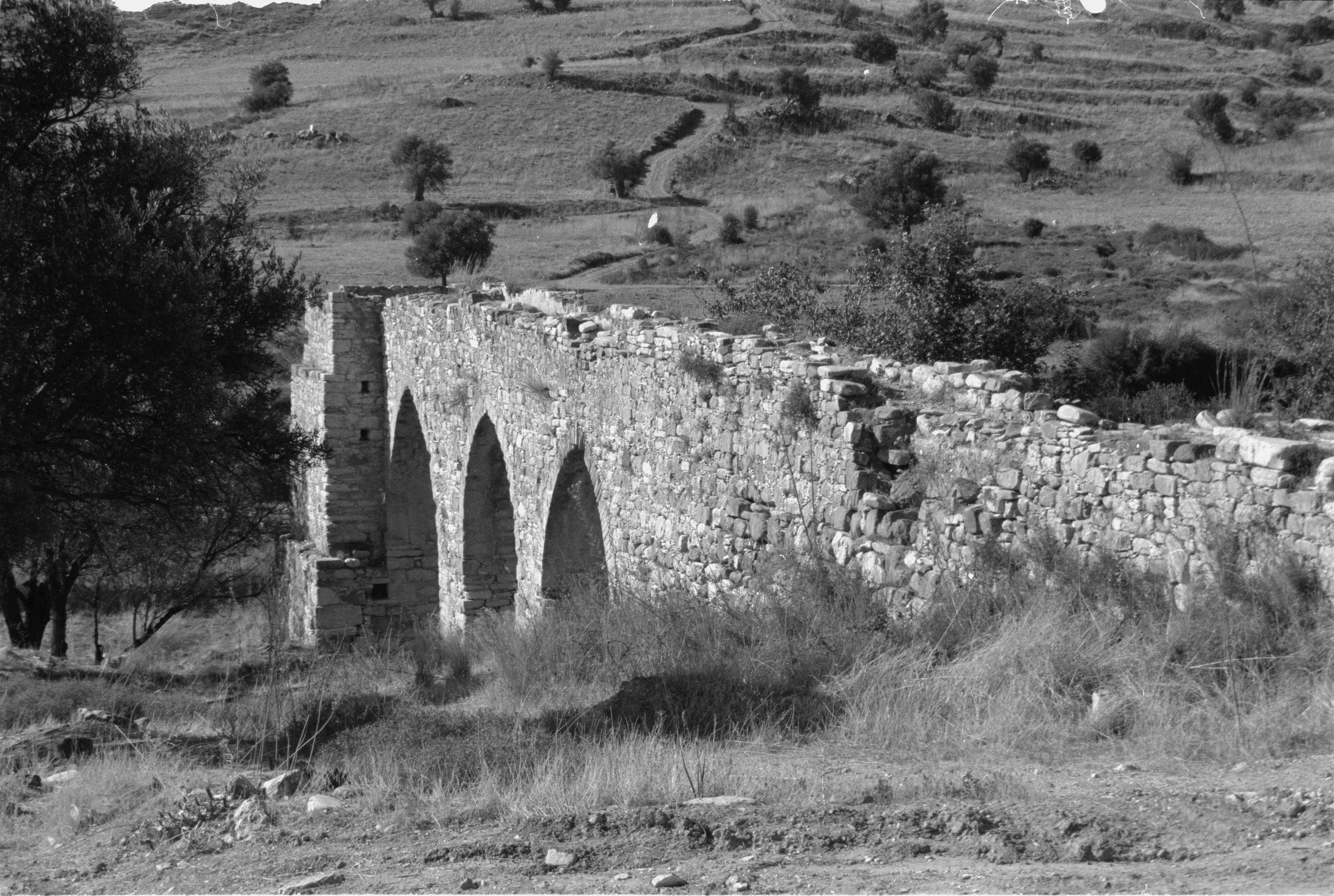
Vretsia (Tis Rodkias or Tou Routhkia)
Type: Watermill
District: Paphos
Village: Vretsia
River: Xeros
Location - Toponym: Makria Chorafia
Cadastral Info: Sheet/Plan: 46/12, Plot. 503.
(1)-thumb.jpg)
Mill Description
The mill is built on a downhill slope and is surrounded by fields with dense vegetation. Water for the operation of the mill was collected from the Xeros river. The surviving buildings of the mill include the stone-built aqueduct and the watertower. The aqueduct is 13m long and after the first 3m of its course it becomes curvy, leading to the upper part of the watertower. Its masonry consists of large stones on the upper part while smaller stones have been used for the rest of its construction. Notched stones (dhisia) have been used in order to facilitate the flow of the water. The lower part as well as the interior of the water channel are coated with hydraulic limestone plaster. The water channel runs on a stout masonry wall, which is interrupted by an arch. The arch is pointed with a maximum height of 2.60m and a base width of 3.30m. On the lower part of the pointed arch there are dressed cornerstones while the rest of the cornerstones have been removed from both sides. The aqueduct and the watertower are built of white limestone while river cobbles have also been used. The watertower is rectangular, with external dimensions 3.80mx2.90m and has a slightly inclined façade without tiers. Stones have been removed from its upper part. The opening of its shaft has the shape of an inverted truncated pyramid, the walls of which have a slight inclination and are covered with hydraulic plaster. In front of the watertower a rural road is passing. The mill, which belonged to the Kykkos Monastery, is mentioned in documents of the 18th and 19th centuries respectively. According to these documents the Mill of Rodkias was one of the most important watermills in the possession of the Kykkos Monastery (See: Perdikis 2006: 110-112). It seems that there were two mills in the area, one on the upper and one on the lower part of the village. E. Egoumenidou & E. Kalliri +
Photos
(1).jpg)
Vretsia A. Pitta & A. Theodosiou (1)(1).jpg
.JPG)
Vretsia A. Pitta & A. Theodosiou (1).JPG
(1).jpg)
Vretsia A. Pitta & A. Theodosiou (10)(1).jpg
.JPG)
Vretsia A. Pitta & A. Theodosiou (10).JPG
(1).jpg)
Vretsia A. Pitta & A. Theodosiou (11)(1).jpg
(2).JPG)
Vretsia A. Pitta & A. Theodosiou (11)(2).JPG
.JPG)
Vretsia A. Pitta & A. Theodosiou (11).JPG
.jpg)
Vretsia A. Pitta & A. Theodosiou (12).jpg
(1).jpg)
Vretsia A. Pitta & A. Theodosiou (2)(1).jpg
.JPG)
Vretsia A. Pitta & A. Theodosiou (2).JPG
(1).jpg)
Vretsia A. Pitta & A. Theodosiou (3)(1).jpg
.JPG)
Vretsia A. Pitta & A. Theodosiou (3).JPG
(1).jpg)
Vretsia A. Pitta & A. Theodosiou (4)(1).jpg
.JPG)
Vretsia A. Pitta & A. Theodosiou (4).JPG
(1).jpg)
Vretsia A. Pitta & A. Theodosiou (5)(1).jpg
.JPG)
Vretsia A. Pitta & A. Theodosiou (5).JPG
(1).JPG)
Vretsia A. Pitta & A. Theodosiou (6)(1).JPG
.jpg)
Vretsia A. Pitta & A. Theodosiou (6).jpg
(1).JPG)
Vretsia A. Pitta & A. Theodosiou (7)(1).JPG
.jpg)
Vretsia A. Pitta & A. Theodosiou (7).jpg
(1).JPG)
Vretsia A. Pitta & A. Theodosiou (8)(1).JPG
.jpg)
Vretsia A. Pitta & A. Theodosiou (8).jpg
(1).JPG)
Vretsia A. Pitta & A. Theodosiou (9)(1).JPG
.jpg)
Vretsia A. Pitta & A. Theodosiou (9).jpg
.jpg)
Vretsia Cyprus Department of Antiquities photographic archive (2).jpg